

Dimethyl Safranin
Description
Dimethyl safranin is a synthetic cationic dye belonging to the phenazine family, commonly used as a biological stain and redox indicator. Chemically, it is a derivative of safranin in which two methyl groups are introduced, typically enhancing its solubility and staining properties. It appears as a deep red or reddish-purple crystalline powder and exhibits strong affinity for acidic cellular components such as nucleic acids, making it particularly useful for staining nuclei in histology and microbiology. In addition to its staining applications, dimethyl safranin functions as a redox indicator in analytical chemistry, undergoing reversible color changes depending on its oxidation state. Its usage requires careful handling due to its potential toxicity and irritant properties, and it is soluble in water and alcohols, which facilitates its incorporation into various staining protocols and biochemical assays.
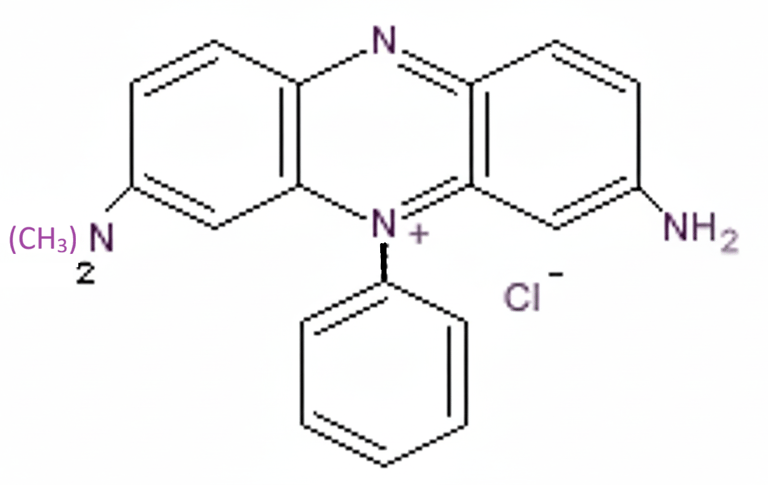

Structure of Diethyl Safranine
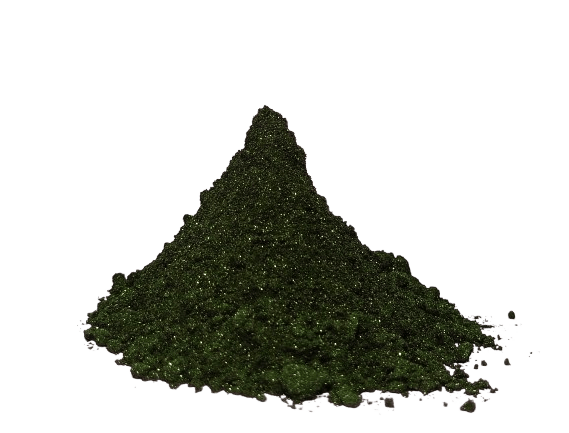
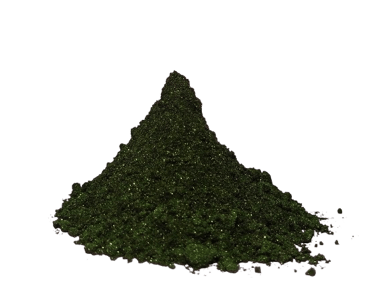
Appearance of Dimethyl Safranin
Molecular Formula
CAS No.
CI No.
IUPAC Name
Synonyms
Molecular Weight
Appearance
Dye Content
(Spectrophotometry)
C₁₇H₁₉N₄Cl
2390-56-9
50220
3,7-Dimethyl-2,8-diamino-phenazine chloride (commonly as the chloride salt)
METHYLENE VIOLET 3RAX
332.82 g/mol
Deep red to reddish-purple crystalline powder
98%
Uses
1. Cytological Research: Dimethyl safranin is used to study cell cycle and chromosome behavior, especially in plant and animal cells. Its strong affinity for DNA makes it useful for observing mitotic phases, nucleoli, and chromatin condensation.
2. Plant Anatomy & Botany: Beyond general lignified tissue staining, it is used in wood identification, xylem analysis, and vascular tissue differentiation, helping botanists and foresters study structural details of plant stems, roots, and leaves.
3. Redox Chemistry & Biochemistry: In addition to being a redox indicator, it is used in enzyme activity assays and electron transfer studies, where its color change reports the oxidation state of biochemical compounds.
4. Environmental & Soil Studies: Occasionally, dimethyl safranin is used in soil microbiology to visualize microbial populations, biofilms, or plant-microbe interactions in rhizosphere studies.
5. Educational Demonstrations: In classrooms, it demonstrates acid-base interactions, staining techniques, and differential tissue identification in simple, visual experiments.
6. Histopathology & Medical Research: It helps detect cellular abnormalities in tissue biopsies, particularly when examining fibrous tissues or connective tissue patterns. While not as commonly used as hematoxylin-eosin, it serves as a supplementary dye for highlighting specific tissue structures.
7. Industrial Applications: In some dye chemistry and textile experiments, dimethyl safranin is explored for fabric staining and colorfastness studies, although this is limited due to cost and toxicity.
Packing
Export Worthy Packing.
Storage Conditions
Store in room temperature
:
:
:
:
:
:
:
:
Contact
Reach out with questions or service requests
Phone
© 2023-2025, All Rights reserved by AADHAV Remedies Pvt Ltd.