
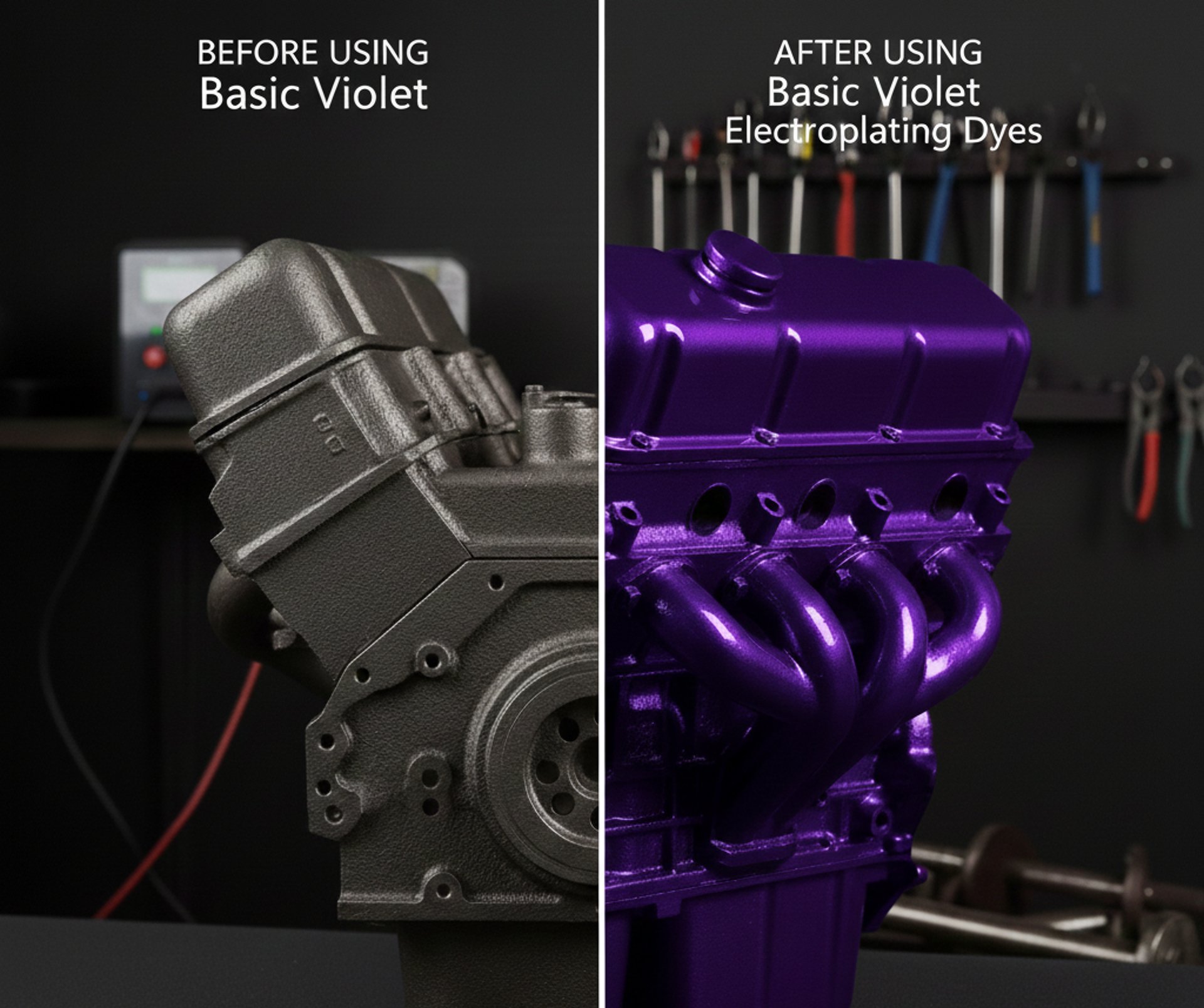
Basic Violet-8
Description
Basic Violet-8 is a synthetic cationic (basic) dye from the triarylmethane dye family, commonly used for coloring textiles, paper, and certain biological specimens. It typically appears as a dark green to purple crystalline powder that produces vivid violet solutions in water and alcohol. Like other basic dyes, it has strong affinity for materials containing acidic groups, giving bright, intense shades. Basic Violet-8 is also used in inks and some industrial colorants, though its use may be regulated due to concerns about dye toxicity and potential environmental persistence.
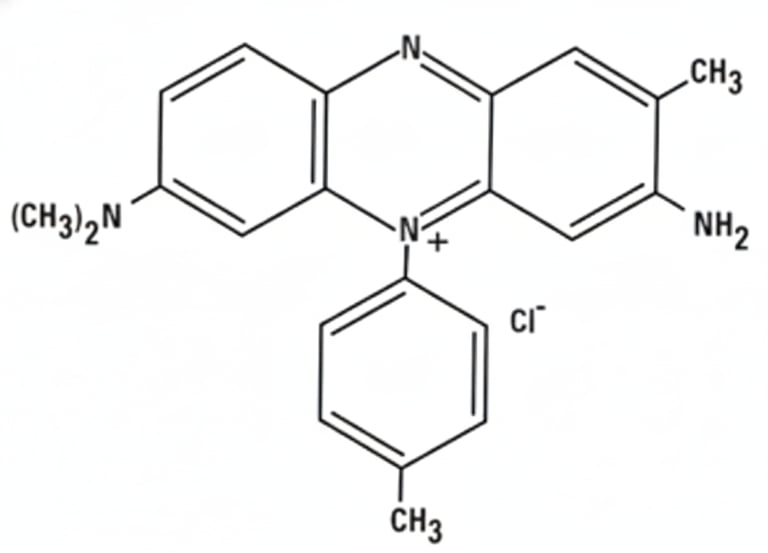
Structure of Diethyl Safranine
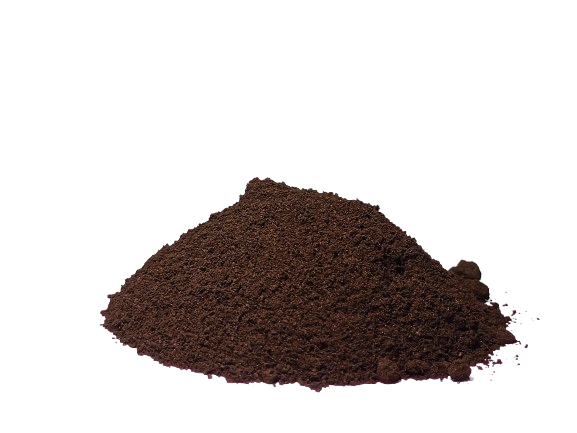
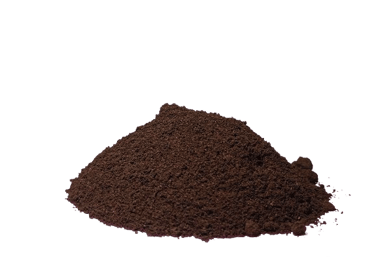
Appearance of Diethyl Safranine
Molecular Formula
CAS No.
CI No.
IUPAC Name
Synonyms
Molecular Weight
Appearance
Solubility
Dye Content
(Spectrophotometry)
C₂₁H₂₁ClN₄
8004-94-2
50210
3-amino-7-(dimethylamino)-5-phenyl-5λ⁵- phenazin-5- ylium chloride
Phenazinium, 2-amino-8 (dimethylamino)- 10-phenyl- chloride
364.87 g/mol
purple solid
Soluble in water
98%
Uses
1. Textile Dyeing and Finishing
2. Paper Coloring
Tissue papers and crepe papers: Gives a vivid violet/magenta hue; used in decorative paper products.
Stationery and craft papers: Mixed with other colorants to create pastel or deep jewel-tone shades.
Security papers: Occasionally used in low-level security applications where color reactions or fluorescence can help distinguish authenticity.
3. Ink and Printing Applications
Packing
Export Worthy packing.
Storage Conditions
Store in room temperature
Acrylic fibers: One of the primary uses; it binds strongly to the anionic sites on acrylic fibers, producing bright, high-tinctorial-strength violet shades.
Polyester and nylon (modified): Sometimes used in blends or mixed dye baths to adjust hue or brightness.
Dyeing auxiliaries: Employed as a component in multi-dye formulations to achieve specific violet or magenta tones.
Color fastness adjustments: Added in small quantities to modify undertones or improve visual brilliance in fabric finishing.
Tissue papers and crepe papers: Gives a vivid violet/magenta hue; used in decorative paper products.
Stationery and craft papers: Mixed with other colorants to create pastel or deep jewel-tone shades.
Security papers: Occasionally used in low-level security applications where color reactions or fluorescence can help distinguish authenticity.
4. Biological and Microscopy Staining
General histological stains: As a triarylmethane dye, it can bind acidic cellular components, creating contrast in tissue samples.
Bacterial staining: Sometimes used as a counterstain in certain microbiological protocols (though less common than crystal violet or safranin).
Fluorescence applications: Exhibits fluorescence under certain conditions, allowing enhanced visibility of stained structures.
5. Chemical Indicator and Analytical Uses
pH-sensitive coloration: Although not a standard indicator dye, its color intensity can shift subtly with pH, making it useful in certain experimental setups.
Dye tracer studies: Bright coloration and detectability at low concentrations allow use in tracking fluid movement in laboratory-scale systems.
6. Plastics and Polymer Coloring
Thermoplastic processing: Used in small quantities to tint plastics such as polystyrene, PVC, and acrylic resins.
Masterbatch formulations: Added as part of concentrated pigment pellets to introduce purple/violet shades into final polymer products.
Colored coatings for plastics: Included in solvent-based coatings where high brilliance is desired.
7. Leather Finishing
Added to finishing agents to produce tinted or fashion-grade leathers, especially for accessories and decorative leather goods.
8. Art, Craft, and Consumer Products
Thermoplastic processing: Used in small quantities to tint plastics such as polystyrene, PVC, and acrylic resins.
Masterbatch formulations: Added as part of concentrated pigment pellets to introduce purple/violet shades into final polymer products.
Colored coatings for plastics: Included in solvent-based coatings where high brilliance is desired.
9. Industrial Colorants and Specialty Coatings
Wood stains and varnishes: Used to modify undertones or add unique tints.
Resin-based coatings and lacquers: Adds purple hues in decorative or functional coatings.
Spectrophotometric studies: Its strong absorbance and color intensity make it useful in calibration or demonstration experiments.
Chemical reaction visualization: Allows easy monitoring of mixing, diffusion, or reaction progress due to its high visibility.
:
:
:
:
:
:
:
:
:
10. Research and Laboratory Uses
Contact
Reach out with questions or service requests
Phone
© 2023-2025, All Rights reserved by AADHAV Remedies Pvt Ltd.